April 4th 2024 | Jessica Van Tassel
Edited by Yasmina
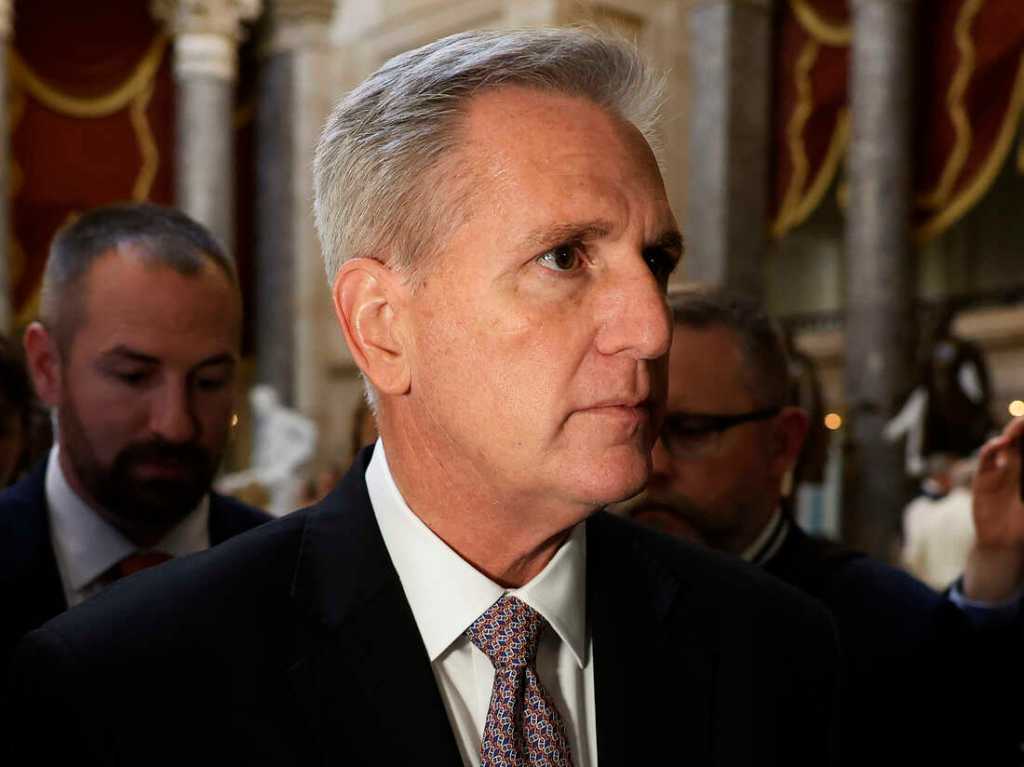
On October 3rd, 2023, for the first time in American history, a house speaker was ousted less than a year after their appointment. This unprecedented situation followed Kevin McCarthy’s challenging selection as House Speaker, a process hindered by internal party disagreements. A key faction of far-right Republicans played a pivotal role in the difficulties faced during his election and eventual removal. The subsequent search for a new Speaker highlighted the party’s internal divisions and the growing influence of extremist elements.
In a motion led by Florida Rep. Matt Gaetz, McCarthy was removed from his position as speaker, setting in motion unforeseen protocols for a speaker-less House of Representatives. Over the following three weeks, the Republican Party struggled to nominate a successor who could unite their party. Eventually, Mike Johnson, a Louisiana representative, was voted in as the 56th speaker of the House of Representatives. Johnson is a constitutional lawyer from Louisiana described by the New York Times as “the most important architect of the Electoral College objections”[1] amidst 2020 claims of election fraud. He presented to his party a constitutional argument against the voting procedures adapted for COVID-19, claiming they were unconstitutional and thereby invalidating the Electoral College results.
The actions of these extremist politicians act as reminders of our government’s dependency on the good faith of elected politicians. Both the orchestration of McCarthy’s removal and Johnson’s role in election disputes underscore the troubling exploitation of the U.S. Constitution revealing vulnerabilities that threaten the very integrity of American democracy.
After nearly three centuries, the continued use of the United States’ original constitution serves as a testament to the triumphs of our government. This foundational document is a crucial component of the structure upon which our country relies. Our constitution was intentionally crafted to transcend the challenges posed by modern advancements. The framers deliberately designed a document capable of adapting to evolving times without excessive detail, allowing for necessary innovation and flexibility. The broad language leaves room for lawmakers to interpret the Constitution as needed. This is a strength that has allowed the United States Constitution to achieve the success it has today, but is also something that can be spun into a weakness. Its failure to account for every possible scenario that may occur within the government leaves a significant dependency upon the good intentions of those elected into office. The gaps and vague diction in our Constitution create a legal vacuum that can be taken advantage of by those willing to exploit their power to get what they want. Recent years have witnessed troubling examples of just this.
In 2020, former President Trump instigated rumors of election fraud that gained significant traction amongst his base of supporters. There was enough support from his followers that on January 6th, 2020, the day the House was supposed to confirm Joe Biden’s win in the Electoral College, the United States Capitol was stormed in an attempt to overturn the election results. This invasion reflected the vulnerability of the country’s government when its integrity was called into question by those in power. Republicans’ subsequent words were critical, as an endorsement of such behavior would set a troubling new standard for our nation, while condemnation would help maintain peaceful transfers of power for the future. Initially, amidst the attack, there were statements made by both Republicans and Democrats urging an end to the violence.
However, the same evening of the attack, a lesser-known Republican representative’s actions set forth a new, dangerous precedent. Typically, the House’s confirmation of Electoral College results is largely considered to be a ceremonial process. The House of Representatives had never previously attempted to overturn the results of the presidential election. Johnson disrupted this long-standing tradition. He provided Republican politicians seeking solidarity with President Trump, and his substantial supporter base, a more socially and politically acceptable alternative than blindly supporting the actions of those who stormed the Capitol. Johnson contended that the voting procedures during COVID-19 were unconstitutional. However, the Constitution does not explicitly grant the House the authority to adjudicate or make decisions regarding states’ voting protocols. The federal government’s framework has traditionally recognized voting procedures as the right of individual states, with Republicans often being staunch advocates for this principle. Yet none of this dissuaded Johnson from creating an official statement regarding the illegitimacy of the election. Johnson’s interpretation of the Constitution offered “a Trojan horse that allowed lawmakers to vote with the president while hiding behind a more defensible case” [2]. That evening, 139 Republicans voted to challenge the results of the Electoral College. This set forth a new precedent. The House had dismissed the people’s voice. Americans had voted Joe Biden into the Presidential Office and over 100 congressional representatives attempted to invalidate these results, all while using the country’s constitution to substantiate their actions. This tension within the Republican party, marked by a willingness to bend constitutional interpretations for political gain, set the stage for the challenges that would arise in January 2023.
In January 2023, when McCarthy was elected as House Speaker, his appointment came with many challenges. Despite holding the majority in the House of Representatives, the Republicans grappled with uniting their ranks behind a single candidate. A small but influential group of far-right extremists withheld their crucial votes, leveraging their power to extract concessions. In response, McCarthy agreed to change some House rules to secure their support, including reducing the threshold for a motion to remove the Speaker. This rule change later played a pivotal role in McCarthy’s ousting as Gaetz utilized it after McCarthy sought support from the minority for a spending plan.
The first-time firing of a House speaker in American history resulted in a three-week state of paralysis as the Republicans scrambled to appoint a new leader. Eventually, after three different nominees, Mike Johnson emerged as the 56th Speaker. The House’s period of paralysis is reflective of its dependency on following its established rules and customs. While the United States Constitution clearly defines the Speaker’s role, it does not go into specifics regarding procedural details, including the removal of a House speaker. Since the House of Representatives is a self-governing body, it establishes its own rules and procedures. Rules and procedures that can be bent to accommodate the demands of a small group of extremists, as demonstrated by the events in recent months. The limited political breadth covered in the Constitution leaves significant room for interpretation and freedom in our government. A characteristic that reveals our government’s reliance on politicians adhering to established customs essential for the effective functioning of the government.
In the last few years, there have been two worrying instances where the country’s constitution was exploited by the emerging far-right faction within the Republican party. These events demonstrate the dangerous trajectory our government is heading. Johnson’s use of the Constitution to justify false claims of election fraud, in combination with the ousting of Speaker McCarthy, act as a reminder of the fragility of the government particularly when in the hands of those willing to exploit constitutional gaps for personal or political gain. Although the Constitution’s broad language has been a strength, allowing for adaptability and interpretation, recent instances have demonstrated its potential weakness when manipulated by politicians driven by personal agendas. In the face of challenges, there is a need to remain vigilant in protecting the democratic principles that have shaped our nation. Recent affairs serve as a stark reminder that the success of our government is not guaranteed, but rather incumbent upon our politicians to actively participate in preserving the ideals that define the United States of America.
Jessica Van Tassel is a sophomore at Johns Hopkins University majoring in Public Health and Economics.
Source:
[1],[2]: Eder, Steve, and David. “They Legitimized the Myth of a Stolen Election – and Reaped the Rewards.” The New York Times, The New York Times, 3 Oct. 2022, www.nytimes.com/2022/10/03/us/politics/republican-election-objectors.html.
Photo Credit: Chip Somodevilla/Getty Images






Leave a Reply